


How To Design Winter Melon Products To Meet Cold Pressing Or Vacuum Packaging Processes?
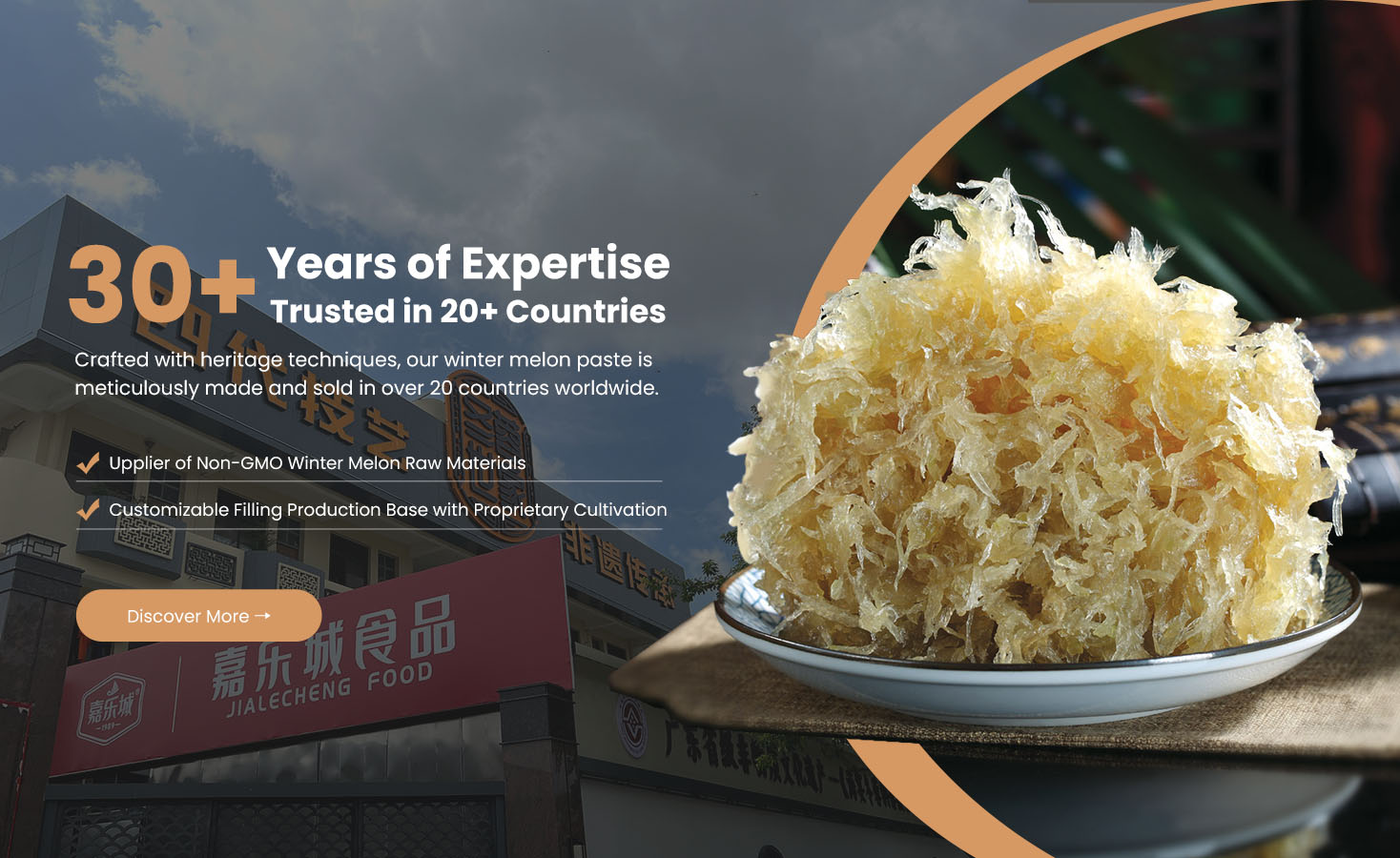
Designing winter melon products for cold pressing or vacuum packaging starts with formula control, structure stability, and a packaging strategy that matches shelf life goals. For winter melon paste, pulp, and filling, the key is to balance moisture, fiber size, sweetness, and viscosity so the product can keep shape, resist separation, and remain stable during storage and transport. JIALECHENG has built this advantage through integrated production, in-house raw material control, and OEM and ODM customization for sweetness, moisture content, and packaging format.
Table of Contents
Manufacturer Vs Trader
A direct manufacturer can adjust product design inside the production system, while a trader usually cannot control process details. JIALECHENG’s published workflow covers raw material selection, cleaning, peeling, cutting, pulping, heating or sterilization, and final packaging. That matters when a customer needs winter melon products that fit vacuum bags, retail packs, or industrial pouches without texture drift.
Manufacturing Process Overview
To match cold pressing or vacuum packaging processes, the product should be designed around four points. First, moisture must be controlled to reduce purge and prevent unstable texture. Second, pulp particle size should be uniform so pressure does not create uneven compression. Third, the sugar and solids ratio should support shelf stability. Fourth, filling temperature before sealing should be consistent to protect seal quality and batch accuracy. JIALECHENG already uses automated vacuum sealing systems and offers 1 kg, 5 kg, 10 kg, and 20 to 25 kg packing options for different supply models.
Quality Control Checkpoints
| Checkpoint | Why it matters |
|---|---|
| Raw material grading | Keeps fiber and moisture stable |
| Brix and moisture testing | Supports repeatable texture |
| Temperature control before filling | Protects sealing performance |
| Weight verification | Improves batch consistency |
| Metal detection | Supports food safety |
| Batch coding | Enables traceability |
JIALECHENG states that its packing stage includes metal detection, weight verification, and batch coding for full traceability. These are critical checkpoints for bulk supply and project sourcing.
OEM ODM Process And Bulk Supply Considerations
For OEM or ODM development, the supplier should confirm target texture, pack size, vacuum level, storage condition, transport cycle, and shelf life target before pilot production. JIALECHENG supports customization of recipe and package format, which is useful for bakery factories, retail channels, and export customers needing different product structures. A practical sourcing checklist should also include retained samples, pallet pattern, seal integrity tests, and labeling approval.
Material Standards Used And Export Market Compliance
Export design must follow food hygiene and labeling requirements, not only packaging appearance. Codex General Principles of Food Hygiene sets the baseline for good hygiene practices and HACCP-based control. FDA explains that vacuum packed foods require controlled processing, and it defines low-acid canned food as products with finished equilibrium pH above 4.6 and water activity above 0.85. These rules make product design, thermal process, packaging barrier, and documentation part of one compliance system.
Conclusion
To design winter melon products for cold pressing or vacuum packaging, the most effective strategy is to align formula, process, and package from the start. Stable moisture, controlled fiber structure, verified sealing, and export-ready documentation all matter. JIALECHENG’s integrated manufacturing model, vacuum packaging capability, and OEM ODM flexibility make it better suited to deliver repeatable quality than a supply model that only trades finished goods.