


What Is Winter Melon Filling Made Of?
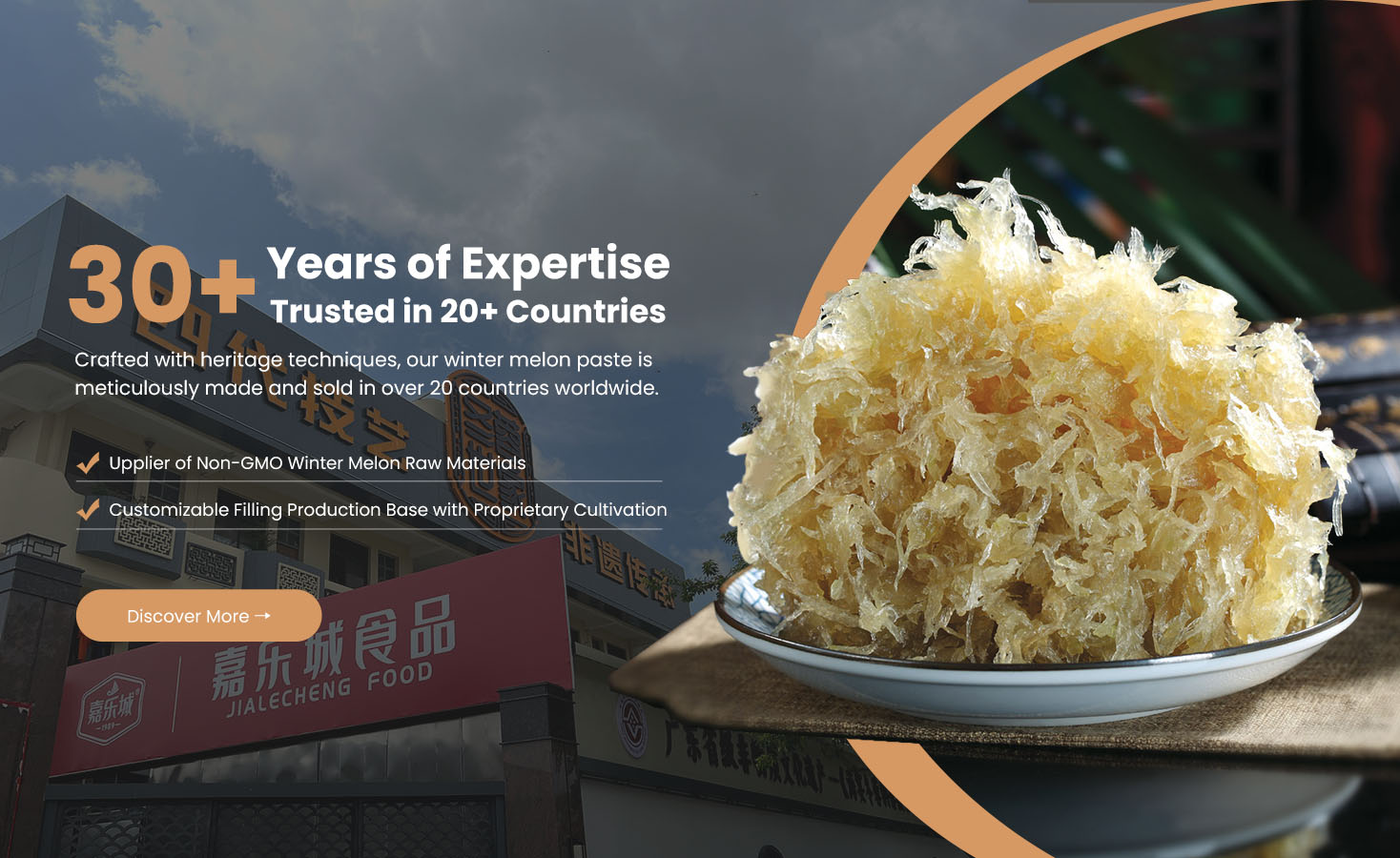
Winter Melon Filling is usually made from winter melon as the base ingredient, then balanced with sweeteners and texture-supporting ingredients so it can perform reliably in pastries, mooncakes, and other baked foods. On JIALECHENG’s product pages, Winter Melon Filling is presented as a commercial bakery filling with winter melon as the core material, while related product pages describe Sweet Winter Melon Paste as being made by slowly cooking finely chopped winter melon with refined sugar. This shows that the essential formula begins with winter melon and sweetening agents, then develops into a controlled filling system for industrial use.
Table of Contents
Core Ingredients In Commercial Winter Melon Filling
In food manufacturing, the ingredient structure of winter melon filling is shaped by application needs. JIALECHENG’s mooncake-specific formulation lists candied winter melon pieces, maltose syrup, maltodextrin, natural flavors, pectin, and edible vegetable oil as main ingredients. Another JIALECHENG OEM product page for the UK market describes a formula made of fresh winter melon pulp, maltose syrup, white sugar, natural pectin, and spices. A separate product page for longevity peach bun filling lists fresh winter melon puree, oligosaccharides, vegetable oil, and maltose syrup. Taken together, these formulations show that commercial winter melon filling commonly combines a winter melon base with sweeteners, texture stabilizers, and selected flavor-supporting ingredients.
Why These Ingredients Matter In Manufacturing
Each ingredient has a processing role. Winter melon provides the base flavor, moisture, and natural fiber structure. Maltose syrup, white sugar, or oligosaccharides support sweetness and solids balance. Pectin helps improve filling stability and structure during forming and baking. Vegetable oil can improve mouthfeel and reduce dryness. Maltodextrin may help support texture balance in certain baking formulas. FDA notes that food ingredients are used for functions such as emulsification, stabilization, thickening, and sweetening, and they must meet the same safety standard whether naturally or artificially derived.
Manufacturer Vs Trader
This is where a direct manufacturer has a clear advantage over a trader. A trader may only resell a fixed formula, but a manufacturer can adjust sweetness, fiber level, moisture content, and flavor profile according to product application. JIALECHENG states that it was established in 1989 and focuses on Winter Melon Paste Filling R&D, production, and sales, with OEM and ODM support. Its product pages also state that sweetness, color depth, and winter melon fiber thickness can be customized for different markets and product categories.
Manufacturing Process Overview
The ingredients alone do not define the filling. Process control is equally important. JIALECHENG describes commercial production through raw material inspection, moisture and Brix sampling, controlled cooking, concentration, and packaging. Its filling products are also offered in several pack sizes, including 250 g, 2.5 kg, and 5 kg, which supports different production scales and bulk supply needs. For project sourcing, this matters because a good filling should not only taste right, but also deposit evenly, bake consistently, and remain stable during storage and transport.
Quality Control Checkpoints
| Checkpoint | Why it matters |
|---|---|
| Raw material grading | Keeps base flavor and fiber stable |
| Moisture and Brix control | Supports repeat texture and sweetness |
| Formula standardization | Reduces variation across batches |
| Packaging checks | Protects filling during storage and shipment |
| Batch traceability | Improves recall and audit readiness |
Codex General Principles of Food Hygiene identifies good hygiene practices and HACCP as the basic structure for safe food production across the food chain. That makes ingredient control, process monitoring, and traceability part of the product value, not just internal factory paperwork.
Material Standards And Export Market Compliance
For export markets, ingredient design also has to match labeling rules. U.S. regulations require the common or usual name of each important ingredient to be declared, generally in descending order of predominance by weight, and FDA also requires ingredient disclosure on packaged foods, including allergen-related labeling where applicable. That means a winter melon filling supplier should be able to provide not only a workable formula, but also clear ingredient documentation for market entry.
Conclusion
Winter melon filling is typically made of winter melon, sweeteners such as maltose syrup or sugar, and selected supporting ingredients such as pectin, vegetable oil, maltodextrin, natural flavors, or other formula-specific components. In commercial food manufacturing, the exact composition depends on the product’s baking behavior, texture target, and market requirements. JIALECHENG’s direct manufacturing model, OEM and ODM capability, and controlled production approach make it easier to turn these ingredients into a stable, export-ready filling for large-scale bakery use.